
Canada Express Entry: Your 2025 Guide to Canada PR
For countless individuals and families around the world, Canada represents the ultimate goal: a safe, welcoming country with a high quality of life and abundant opportunities. If you’re a skilled professional dreaming of making Canada your permanent home, the Canada Express Entry system is your primary pathway.
Navigating the world of immigration can feel overwhelming, filled with acronyms and complex rules. But don’t worry. This guide is designed to demystify the process for 2025. We will break down exactly how Canada Express Entry works, from determining your eligibility and calculating your crucial Comprehensive Ranking System (CRS) score to receiving that life-changing Invitation to Apply (ITA) for Permanent Residency (PR).
What is Canada Express Entry?
Launched in 2015, Canada Express Entry is not an immigration program itself. Rather, it is an online system used by Immigration, Refugees and Citizenship Canada (IRCC) to manage and process applications from skilled workers who want to become permanent residents.
It’s a points-based system where candidates are ranked against one another in a pool. The highest-ranking candidates are then invited to apply for PR. It is designed to be a faster, more efficient way for Canada to select immigrants who have the skills and experience to contribute to its economy.
Which Programs Use the Express Entry System?
Express Entry manages applications for three main federal economic immigration programs:
Federal Skilled Worker Program (FSWP): For skilled workers with foreign work experience who want to immigrate to Canada permanently.
Federal Skilled Trades Program (FSTP): For skilled workers who are qualified in a skilled trade.
Canadian Experience Class (CEC): For skilled workers who already have Canadian work experience.
How Does Canada Express Entry Work? A Step-by-Step Guide
The process is logical and sequential. Following these steps carefully is the key to a successful application.
H3: Step 1: Check Your Eligibility
First, you must determine if you are eligible for one of the three programs listed above. For most applicants outside Canada, especially those applying for Canada PR from India, the Federal Skilled Worker Program (FSWP) is the most common entry point. The FSWP uses a separate 100-point grid where you must score at least 67 points based on factors like age, education, work experience, and language skills.
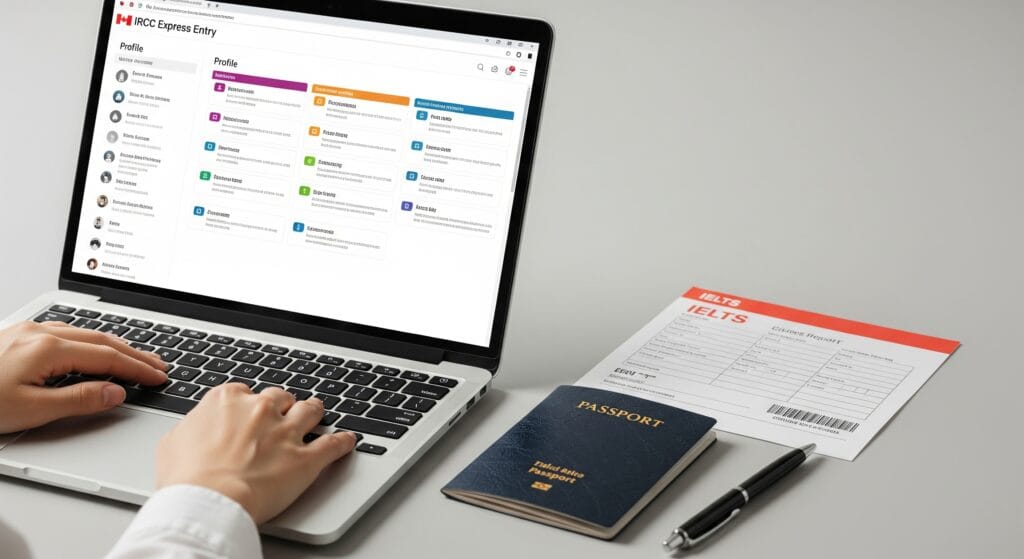
H3: Step 2: Get Your Documents Ready
This is the most time-consuming and critical preparatory phase. Before you can even create a profile, you must have two key things:
Language Test Results: You must take an approved language test (IELTS or CELPIP for English; TEF or TCF for French). Your scores are a major factor in your overall rank.
Educational Credential Assessment (ECA): You must have your foreign education assessed by a designated organization, like World Education Services (WES), to prove it is valid and equal to a Canadian one. This process can take several weeks or months.
H3: Step 3: Calculate Your CRS Score and Submit Your Profile
Once you have your language scores and ECA report, you can create your online Express Entry profile on the official IRCC website. You will enter your details (age, education, experience, etc.), and the system will automatically calculate your Comprehensive Ranking System (CRS) score. This score, out of 1200, determines your rank in the Express Entry pool.
H4: Step 4: Receive an Invitation to Apply (ITA)
IRCC conducts regular “draws” from the Express Entry pool, inviting candidates with scores above a certain cut-off to apply for PR. If your CRS score is high enough, you will receive an Invitation to Apply (ITA). From the date you receive your ITA, you have 60 days to submit a complete and detailed application for permanent residency.
Understanding the Comprehensive Ranking System (CRS) Score
Your CRS score is everything in the Express Entry system. It is what decides whether you receive an ITA. The points are awarded based on:
Core / Human Capital Factors: Age, level of education, language proficiency, and Canadian work experience.
Spouse or Common-law Partner Factors: Your partner’s education, language skills, and work experience can also add points.
Skill Transferability Factors: This section combines your education and work experience with your language skills to award extra points.
Additional Points: You can get a significant boost for having a valid Canadian job offer, a nomination from a Canadian province (PNP), Canadian siblings, or strong French language skills.
You can estimate your score using IRCC’s official CRS score calculator tool.
 Frequently Asked Questions (FAQs)
 Frequently Asked Questions (FAQs)
1. What is a good CRS score in 2025? The CRS cut-off score changes with every draw. In recent years, scores have often been in the 490-520 range for general draws. However, category-based draws for specific occupations (like healthcare or tech) can have lower cut-offs. Aiming for a score above 500 is a strong goal for 2025.
2. How long does the Express Entry process take? After you submit your complete application (post-ITA), IRCC’s processing standard is six months for 80% of cases. However, the initial phase of getting your ECA and language tests can take 3-6 months, and you might wait in the pool for several months before receiving an ITA.
3. Do I need a job offer to apply through Express Entry? No, a job offer is not mandatory to enter the Express Entry pool. However, having a valid Canadian job offer can add 50 or 200 points to your CRS score, significantly increasing your chances of receiving an ITA.
4. How much does it cost to apply for Canada PR through Express Entry? There are several costs: Language tests (~$250 USD), ECA (~$200 USD), application processing fees (CAD $950 per adult), and the Right of Permanent Residence Fee (CAD $575 per adult). You also need to show proof of funds, which for a single applicant is currently CAD $14,690.
Conclusion: Your Strategic Path to Canada
The Canada Express Entry system is a competitive but transparent pathway to achieving your dream of living in Canada. Success hinges on a strategic approach: understanding the requirements, preparing your documents well in advance, and maximizing your CRS score.
Don’t be discouraged if your initial score seems low. Focus on the areas you can improve, such as retaking a language test or exploring Provincial Nominee Programs (PNPs) for a 600-point boost. By being proactive and diligent, you can turn your aspiration of Canadian permanent residency into a reality.