Germany’s robust economy, high quality of life, and demand for skilled professionals make it a top destination for ambitious individuals worldwide. But before you can land your dream job in Berlin’s tech scene or Munich’s engineering hubs, you need a way to get there. For many, the answer is the Germany Job Seeker Visa.
This guide is your comprehensive roadmap for 2025. We understand that the visa process can seem intimidating. That’s why we’ve broken it down into clear, actionable steps. We will cover who is eligible, the detailed application process, crucial financial requirements, and what to do once you arrive in Germany to begin your job hunt. Let’s get you on the path to your new career in Germany.
What is the Germany Job Seeker Visa?
The Germany Job Seeker Visa is a long-stay national visa that allows qualified professionals from non-EU/EEA countries to come to Germany for up to six months to look for a job in their field of expertise.
It’s important to distinguish this from a standard work visa. You do not need a job offer to apply for the Job Seeker Visa. Its sole purpose is to give you the legal right to be in the country while you search for employment. Once you secure a qualifying job offer, you must convert your Job Seeker Visa into a residence permit for work.
Who is Eligible for the Job Seeker Visa in 2025?
Germany is looking for skilled talent. To be eligible, you must demonstrate that you have the qualifications and resources to be a successful candidate in the German job market. The primary requirements focus on your education, experience, and financial stability.
Key Eligibility Criteria:
- Academic Qualification: You must hold a Bachelor’s or Master’s degree from a German university or an equivalent foreign degree. You will need to prove that your degree is recognized in Germany. The Anabin database is the official tool to check your university and degree’s status.
- Professional Experience: You should have a minimum of professional experience relevant to your academic field. While the official minimum can vary, having at least 2-3 years of experience significantly strengthens your application.
- Proof of Financial Resources (Finanzierungsnachweis): You must prove you can support yourself for the entire six-month duration of your stay without relying on public funds. For 2025, this typically means having access to €1,027 per month, or a total of €6,162 for six months. The most common way to prove this is through a blocked account (Sperrkonto).
- Travel Health Insurance: You need valid travel health insurance that covers you from the day you enter Germany until you find a job and can enroll in the statutory German health insurance system.
Step-by-Step Application Process for the Germany Job Seeker Visa
Navigating bureaucracy can be the most challenging part of moving abroad. Follow these steps methodically to ensure a smooth application process.
Step 1: Verify Your Qualifications & Gather Documents.
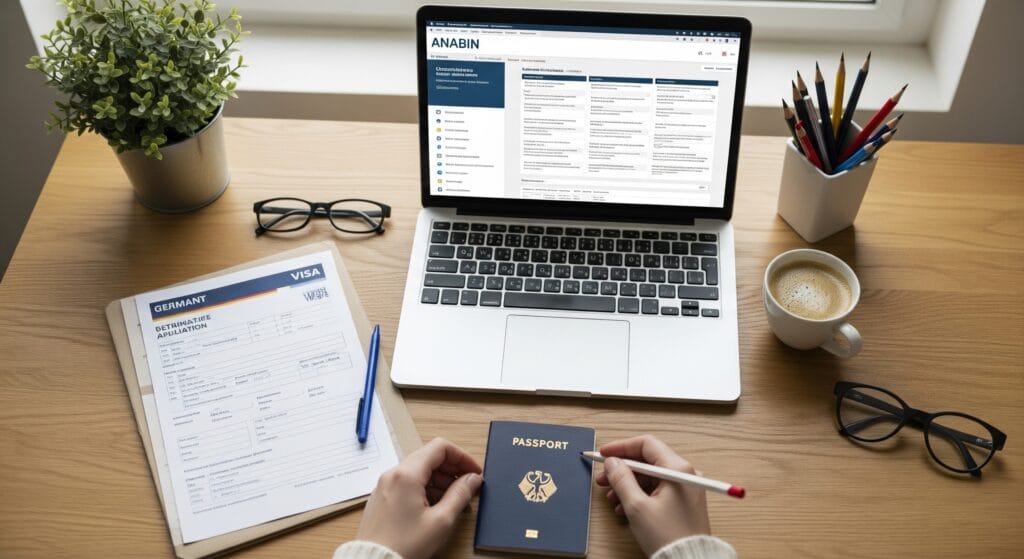
Before you do anything else, confirm your eligibility. Use the Anabin database to check if your university (under “Institutionen”) and degree (under “Hochschulabschlüsse”) are recognized. If your university is listed as “H+” and your degree is marked as “gleichwertig” (equivalent), you are in a good position.
Begin gathering your core documents:
- Your valid passport
- University degree certificate and transcripts
- Proof of work experience (letters from employers)
Step 2: Secure Proof of Financial Resources.
This is a critical step that requires advance planning. The most widely accepted method is opening a blocked account with a provider approved by the German Federal Foreign Office (e.g., Fintiba, Expatrio). You will deposit the required amount (€6,162 for six months as of early 2025 guidance) into this account. The bank will then provide a confirmation certificate for your visa application. You can only withdraw a set monthly amount once you are in Germany.
Step 3: Prepare Your Complete Application File.
Attention to detail is everything. A missing or incorrect document can lead to delays or rejection. Here is a checklist of what you’ll typically need. Always double-check the specific requirements of the German embassy or consulate in your home country.
Document Checklist:
- Two completed national visa application forms.
- Two recent biometric passport photos.
- Your valid passport (with at least 12 months of validity remaining).
- A cover letter explaining the purpose of your visit, your job search plan (target companies, industries), and your plans if you fail to find a job.
- CV (Europass format is recommended).
- Proof of your academic degree (original and a copy, with German translation if required).
- Proof of degree recognition (Anabin printouts).
- Proof of accommodation in Germany for your stay (e.g., temporary hotel booking, letter from a friend).
- Proof of financial means (the blocked account confirmation).
- Proof of travel health insurance.
- Visa application fee (currently €75, payable in local currency).
Step 4: Schedule Your Visa Appointment.
Once your file is complete, you must schedule an appointment at the German embassy or consulate responsible for your jurisdiction. Waiting times can be long, so book your appointment well in advance.
Step 5: Attend the Interview and Submit Your Application
On your appointment day, dress professionally and arrive on time. You will submit your documents and likely be asked a few questions about your qualifications, your job search strategy, and why you want to work in Germany. Be confident and clear in your answers.
Processing times vary but can take anywhere from four to eight weeks, or sometimes longer.
What Happens After You Arrive in Germany?
Congratulations! With your Germany Job Seeker Visa in hand, you can travel to Germany. But your work isn’t done yet.
- Register Your Address (Anmeldung): Within 14 days of moving into your accommodation, you must register your address at the local citizens’ office (Bürgeramt). This is a mandatory legal requirement.
- Focus on the Job Hunt: Use your six months effectively. Network, tailor your CV for German standards, use job portals like StepStone.de, LinkedIn, and Indeed.de, and prepare for interviews.
- Convert Your Visa: Once you receive a job offer that matches your qualifications, you must apply for a German Residence Permit for Employment or an EU Blue Card before your Job Seeker Visa expires. This is done at the local Foreigners’ Authority (Ausländerbehörde). The official German government portal, Make it in Germany, provides excellent resources on this transition.
Common Mistakes to Avoid When Applying.
- Incomplete Documentation: Forgetting a document is the most common reason for rejection. Use a checklist and double-check everything.
- Unrecognized Degree: Failing to verify your degree’s equivalence in the Anabin database beforehand.
- Insufficient Financial Proof: Not setting up the blocked account correctly or not having the full required amount.
- A Vague Cover Letter: Your motivation letter should be specific, outlining the types of jobs and companies you are targeting. Show the visa officer you have a concrete plan. As reported by outlets like DW News, Germany is actively seeking talent, so presenting yourself as a serious candidate is key.
Conclusion: Your Gateway to a German Career.
The Germany Job Seeker Visa is a powerful tool for self-starting professionals who are confident in their skills and determined to build a career in one of Europe’s most dynamic economies. While the process requires careful preparation and attention to detail, it is a well-defined path to opportunity.
By verifying your qualifications, securing your finances, and methodically preparing your application, you can overcome the bureaucratic hurdles. View this process not as an obstacle, but as the first step in an exciting new chapter. With your visa secured, the door to Germany’s thriving job market is wide open for you to walk through.